
等着我
Chinese team develops intelligent vision sensor that turns light signals into AI-ready tokens, reducing use of energy_我的网站

一 |
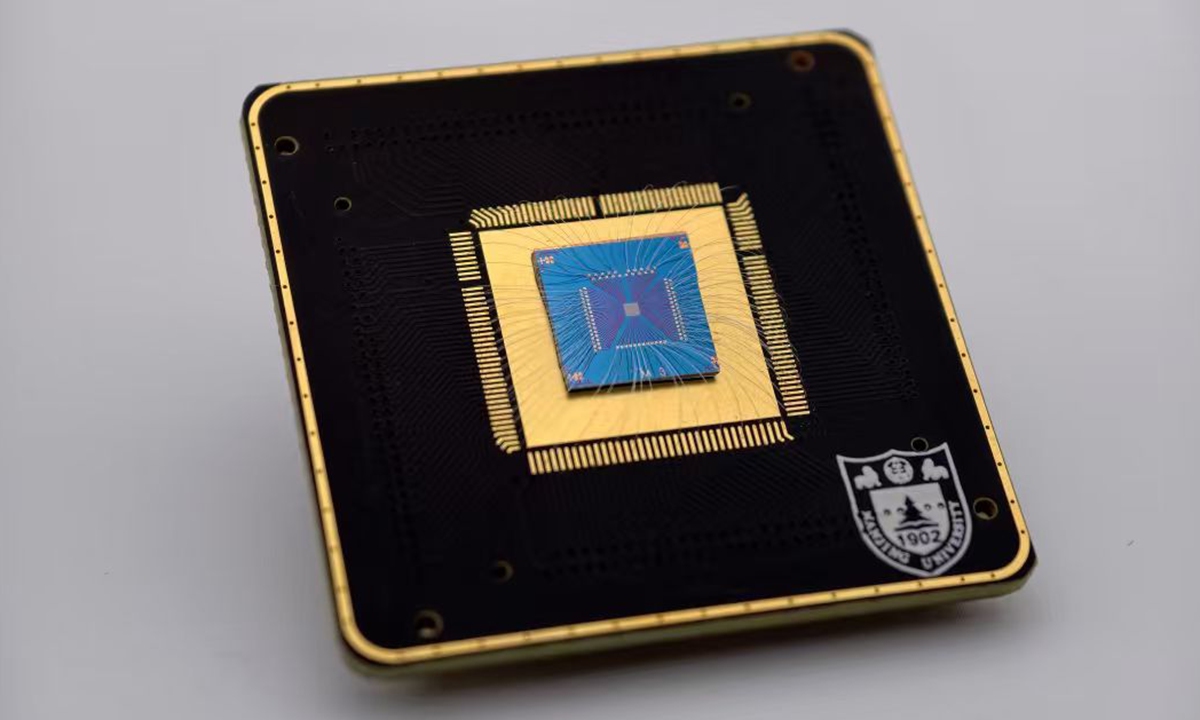
A Chinese research team from Nanjing University has developed a new ultra-low-power intelligent vision sensor chip, dubbed "LightTok," that can convert light signals into tokens within the sensor, significantly reducing the high energy consumption caused by frequent transfers of massive amounts of redundant data, the principal investigator told the Global Times.
According to a release from the Institute of Brain-Inspired Intelligence of Nanjing University, tokens generated by the LightTok chip can be directly fed into a Transformer encoder for image recognition.
"Our design idea was to move token generation onto the sensor itself, allowing the chip to directly produce tokens that AI models can process once light reaches the sensor," Miao Feng, director of the Institute of Brain-Inspired Intelligence at Nanjing University, told the Global Times on Thursday. "These tokens contain complete image information."
Physical AI refers to intelligent systems capable of autonomously perceiving, reasoning, acting and receiving feedback in the real world, representing a key pathway for AI to move from the digital realm into the physical world. Vision-based physical AI systems powered by large AI models need to convert visual information from real-world environments into tokens that can be processed by AI models before feeding these tokens into Transformers for subsequent tasks.
In traditional visual perception pipelines, light signals must go through multiple stages, including image sensing, analog-to-digital conversion, data buffering and transfer, digital image patching and embedding, before being transformed into tokens that AI models can process. The frequent transfer of massive amounts of redundant data has resulted in high energy consumption at the edge, according to a report by Science and Technology Daily.
The LightTok chip directly addresses a key challenge in physical AI hardware: how to efficiently acquire and tokenize visual information from the physical world with low energy consumption, Miao said.
The LightTok chip consists of a photosensitive memory array and peripheral circuits. The team built the array based on single-layer molybdenum disulfide (MoS₂) floating-gate phototransistors, with each pixel capable of sensing light, storing information and performing analog computing. By processing optical information directly within the chip, the device can convert captured visual signals into tokens for AI models, according to the research team.
The current LightTok prototype has a resolution of 32×32 pixels, or 1,024 photosensitive pixels, which is still smaller than that of smartphone cameras and industrial imaging systems. However, Miao said the technology is compatible with CMOS manufacturing processes and can be scaled up. With wafer-level growth of molybdenum disulfide materials, the chip could potentially achieve a scale comparable to existing imaging devices.
Miao said the chip also draws inspiration from the information-processing mechanism of human vision. Similar to how the retina extracts key visual information before transmitting it to the brain, the chip also aims to process visual information at an early stage.
The research was conducted in collaboration with another research team from the National University of Singapore. The findings were published on Wednesday in Nature Sensors, an internationally renowned journal in the field of sensing technology, according to the release.
Potential applications for LightTok include drone systems, autonomous remote sensing and small-scale embodied AI systems, Miao said. In these scenarios, devices need to continuously detect, understand and track targets, generating massive amounts of visual data. By reducing the energy required for visual processing, the technology could extend the operating time of drones, satellites and small robots with limited power supplies, the expert said.
。 2025年全国硕士研究生招生考试,将于12月21日至22日举行,小编为大家带来考试期间天气预报,及考前提醒请及时关注。 抚顺市气象台12月19日14时42分发布“考研”期间天气预报:12月21日~12月23日我市以晴或多云天气为主;气温较低,体感较冷,最低气温-17~-15℃,22~23日最高气温有小幅回升2~4℃;21~22日风力偏大,西北或偏西风3~4级。 建议广大考生做好防寒保暖工作,谨防感冒及其他呼吸系统疾病,并随时关注最新天气预报预警信息,根据天气变化做好相应准备。

二 | 考前提醒: 1考试前,考生应仔细阅读考场规定,了解考试时间、考试要求、准考证携带等相关事项,确保顺利完成考试。

三 | 2考试前,考生应远离冷饮,注意饮食调整。考试期间,不要吃得过饱,也不要空腹考试,早餐要吃好,保持体力和精神状态。

四 | 3提前熟悉考场位置,了解到考点的路线、交通情况,做好出行计划。如住宿地离考点较远,务必提前出发,避免因堵车而耽误考试。 4精神状态至关重要,考前几天不要过度疲劳,科学安排学习时间,保证充足睡眠,保持良好状态。 5冬季考试,考生需要注意保暖问题,穿着要合适,既要保暖又要方便活动,避免影响答题速度。 预祝莘莘学子们,考试顺利、一举夺魁! 责任编辑:李丹。
Current article:http://qm2.tuncuansazhuandengqiaofen.bond/list_ysk3axl/5ir.html
Published on:00:00:00


等着我TXT下载声明:
1 我的网站免费提供的等着我,均由网友上传,供下载测试之用,不作商业用途,下载后请二十四小时后删除!
2 我们根据txt小说全文所整理出等着我txt电子书全集免费下载,由程序自动生成等着我txt下载文件。
3 书友所发表的txt小说等着我的相关评论,并不代表本站赞同等着我txt下载或者支持等着我的读者观点。
4 如果发现小说《等着我txt全集》无法下载未及时更新请联系我们。如果您喜欢等着我txt电子书,请支持作者到书店购买正版图书。感谢您的合作与支持。
5 好看的小说等着我是作者"百年不渡"的最新力作,等着我电子书由网友发布;小说等着我版权属于作者所有,如果侵犯您的利益,请通知我们。